
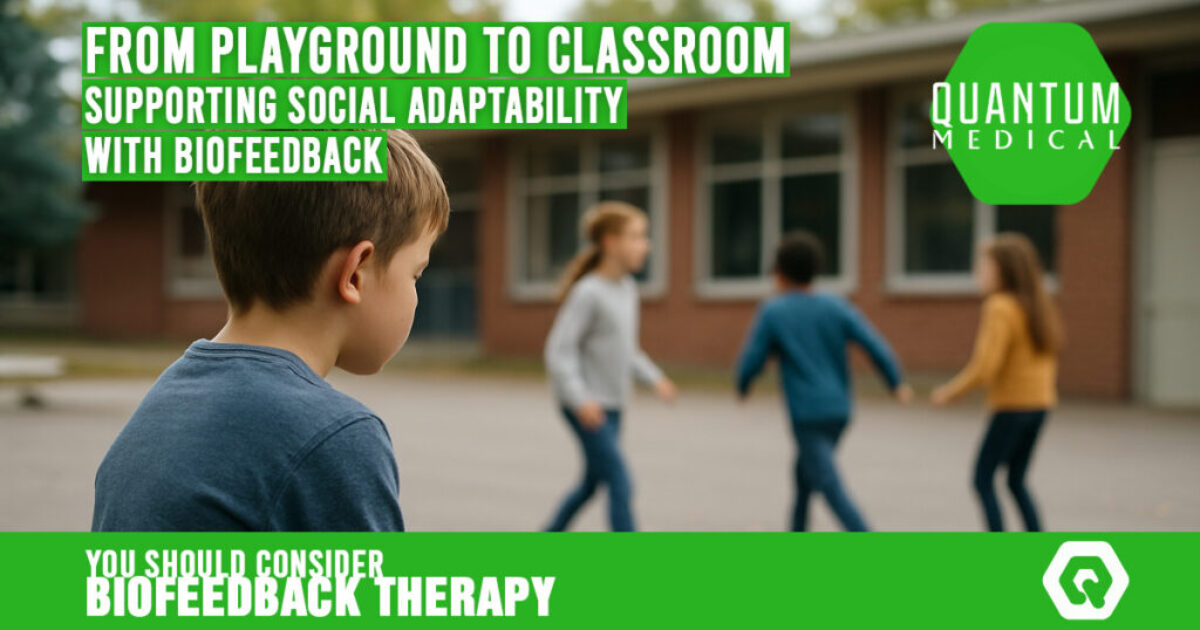

From Playground to Classroom - Supporting Social Adaptability with Biofeedback
Starting school, changing classes, making new friends—all of these are part of a child’s journey from playground games to classroom routines. For many children, these transitions are exciting. But for others, social anxiety, physical stress responses, and difficulties self-regulating can make this shift difficult. In this article, we explore how biofeedback can help children recognize the physical signs of social anxiety, practice self-regulation, and improve peer interactions. We’ll give concrete advice parents can use, case examples, and describe how modern biofeedback tools like NUCLEUS and ED.X from Quantum Medical can play a powerful role.
What is Social Adaptability, and Why It Matters
- Social adaptability refers to a child’s ability to adjust to new social environments: making friends, responding to social cues, recovering from awkward or stressful interactions.
- When students adapt well socially, they tend to do better academically, have fewer behavior problems, feel more confident, and report greater well-being.
- Social anxiety, or simply feeling nervous in social settings, triggers physical responses (e.g. increased heart rate, sweaty palms, shallow breathing) that can interfere with peer interaction.
What Is Biofeedback & How It Helps
Biofeedback is a method that gives real-time feedback to a person about physiological signals (such as heart rate, breathing rate, skin conductance), so they can learn to control them—or at least recognize when they’re triggered.
Key biofeedback principles for social adaptability:
1. Awareness: Recognizing early physical signs of anxiety (e.g. racing heart, tension
2. Self-regulation: Using techniques (breathing, grounding, relaxation) to reduce arousal
3. Practice: Doing it often so that when children are actually in stress-provoking social situations (in the playground, before class, during group work), they can more readily bring themselves back to a calmer state.
Scientific studies show that interventions like heart‐rate variability (HRV) biofeedback can reduce anxiety and social stress in children. Also, biofeedback‐assisted relaxation training has been useful in decreasing anxiety among youths.
Using Biofeedback to Build Self-Regulation
Once awareness is in place, biofeedback allows children to practice reducing their physiological arousal. Here are steps parents can take:
1. Choose tools or sessions
- A biofeedback device or program (could be at a clinic, at home) that measures one or more signals: heart rate / HRV, breathing, galvanic skin response (sweat/skin conductivity).
- Devices like NUCLEUS or ED.X from Quantum Medical are well suited because they can capture multiple physiological signals (heart rate, skin conductance, respiration etc.) in real time, giving children and parents more fine-grained data for self-regulation. Also, these devices provide visual or auditory feedback, making the biofeedback process engaging and understandable.
2. Set up regular, safe practice sessions
- Start with low-stakes social anxiety triggers (e.g. talking to family, sharing in small group).
- Use guided breathing, progressive muscle relaxation, or visualization, while watching the feedback. For example: slow deep breathing until heart-rate variability improves; noticing skin conductivity decreasing.
3. Teach coping strategies tied to the feedback
Some examples:
- Slow diaphragmatic breathing: breathing in for 4 counts, hold 2, out for 6, etc. Monitor pulse / HRV curve.
- Progressive muscle relaxation: tensing and relaxing muscle groups. Notice how tension shows up in feedback (e.g. elevated skin conductance) and how relaxing reduces it.
- Visualization or grounding: When feedback indicates stress rising, child can visualize a calm place, count objects around, or focus on senses.
4. Practice “in the moment”
Once children are comfortable with practice, try using biofeedback in real social situations (playground, before class, group projects). This might involve having a portable device (if available), or using what they’ve learned (breathing, relaxation) and recalling what the feedback showed them.
5. Reflection and reinforcement
- After social interactions, talk through what the child noticed physically, what they did, what helped, what didn’t.
- Celebrate successes (even small ones) in staying calm, speaking up, joining in.
- Adjust practices as needed: maybe focus more on breathing, or muscle tension, depending on which physical signals seem most disruptive.
Practical Tips for Parents: How to Support Your Child
Here are actionable tips parents can follow to help their child use biofeedback to support social adaptability in school settings.
1. Equip with the right tool or access
- If you don’t already have a biofeedback device, look for devices that are child-friendly, provide visual feedback, measure relevant signals (heart rate, breathing, skin conductance).
- Devices like Quantum Medical’s NUCLEUS and ED.X are examples—they allow multiple physiological signals to be measured and displayed in real time, which can help children and parents see what’s happening in the body, tailor self-regulation accordingly.
2. Create a predictable routine
- Practice biofeedback at consistent times: perhaps after school, or after homework, when stress levels tend to build up.
- Use short sessions initially (5-10 minutes), then gradually increase as the child becomes more comfortable.
3. Combine biofeedback with emotional coaching
- Help children put words to their feelings and bodily signs (“I feel jittery, my heart is beating fast”).
- Use stories or metaphors: “Your body’s like an alarm—it’s trying to warn you when you’re uneasy, and biofeedback helps you turn down the volume of that alarm.”
4. Simulate social situations in safe environments
- Role play: practice greetings, answering questions, joining groups, speaking in front of parents or siblings. While doing so, use the biofeedback device to notice what happens physically.
- Gradual exposure: small group settings, then larger, gradually increasing social challenge.
5. Teach quick‐relief tools children can use on their own
- Deep breathing, counting backwards, focusing on senses (5 things you can see, 4 you can touch, etc.)
- Use handheld tools: textured object to squeeze, card with breathing steps. Knowing these tools helps children when biofeedback device isn’t available.
6. Involve school / teacher
- Let teacher know what the child is working on. Teacher can give gentle reminders, allow short breaks, allow breathing or grounding before presentations.
- Perhaps have biofeedback sessions at school (if feasible) or share biofeedback insights with school counselor.
7. Track progress and celebrate wins
- Keep a simple log: what happened, what the child noticed, what strategy was tried, what worked.
- Celebrate small advances: more eye contact, speaking up once, joining game, etc. Positive reinforcement builds confidence.
Advantages of Using Biofeedback Devices
- Multimodal signal detection: Both NUCLEUS and ED.X devices from Quantum Medical allow measurement of several physiological signals in real time—heart rate, respiration rate, skin conductance (GSR), etc.—which helps children and parents to see, more precisely, the onset and intensity of social anxiety. This granularity aids better self-regulation.
- Engagement and usability: These devices provide visual or auditory feedback that is intuitive for children, making practice more engaging. The NUCLEUS especially includes newer features and programs compared to earlier models, offering more flexibility in protocols suited for social anxiety or peer interaction scenarios.
Bringing It All Together: Why Biofeedback Helps Social Adaptability
- Biofeedback gives objective evidence of what the body is doing in social stress. Instead of just “I feel anxious,” children can see the physical changes and know they are real—and that they can influence them.
- Repeated practice builds self-efficacy: the more a child uses breathing, grounding, or other techniques and sees the feedback change, the more confidence they gain. That translates into more willingness to interact, to speak up, to join peer groups.
- Over time, these skills generalize: children become better at regulating stress without needing the device exactly in the moment. The physical cues alert them, and they employ strategies.
Social adaptability—making friends, participating, managing new social challenges—is a critical part of a child’s success at school. When social anxiety shows up physically, those bodily signals can become barriers. Biofeedback provides a way for children to recognize those signs, learn to self-regulate, and gradually gain confidence in social settings. Parents play a central role: noticing symptoms, providing tools, supporting practice, reinforcing strategies.
Tools like Quantum Medical’s NUCLEUS and ED.X devices are powerful in this journey because they allow children to see real data about their physiological arousal, practice with feedback, and build self-regulation skills that generalize into school life.